
This article looks at the effects of antioxidant juice on recovery from downhill running
What’s the deal?
Anyone who has ever run downhill for an extended time knows that you struggle to walk for days after. Could a drink rich in antioxidants help to speed up recovery?
What did they do?
30 volunteers were given an experimental drink twice a day, every day for 9 days. Half of the participants had antioxidant juice and the other half had a placebo drink. On the 5th day, participants ran downhill (-15%) for 30 minutes at 70% effort. Running economy and muscle soreness (DOMS) were then evaluated immediately after the downhill run and daily thereafter.
What happened?
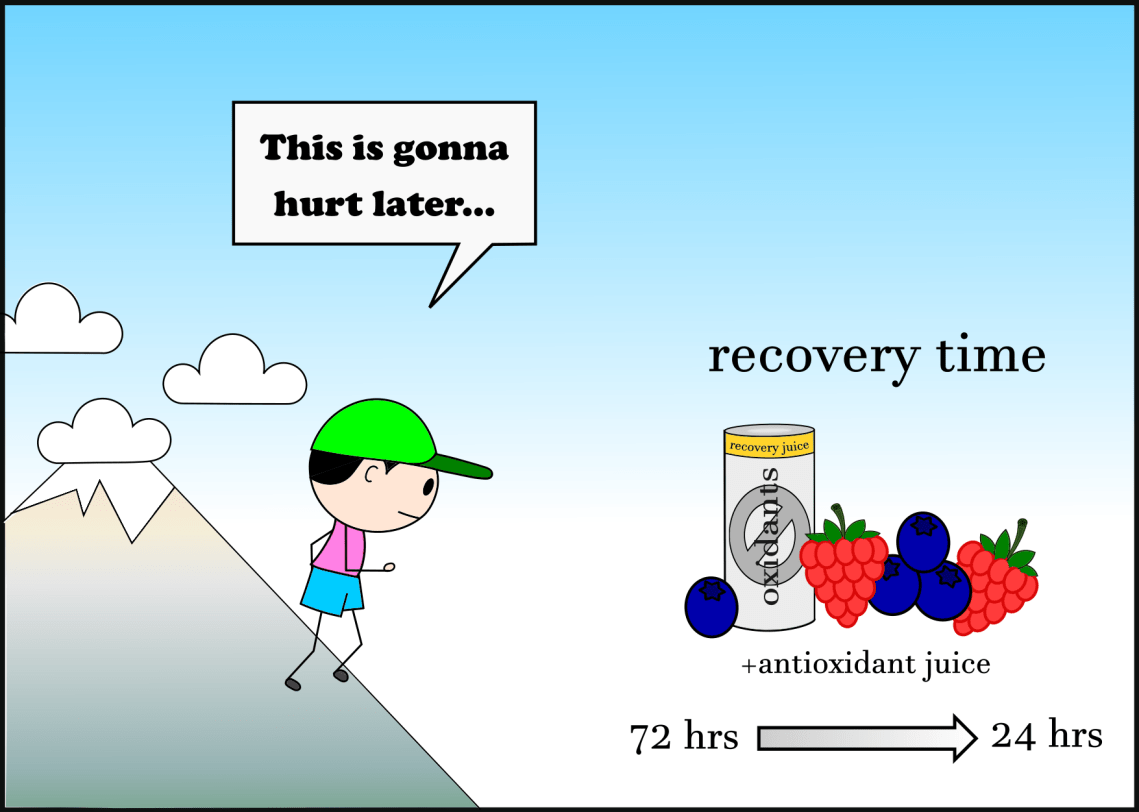
Running economy declined and muscle soreness increased after downhill running in both groups, as expected. The recovery of running economy was faster in the antioxidant juice group (24 hours) than in the placebo group (72 hours). Additionally, muscle soreness in the antioxidant group throughout the study was always lower than in the placebo group.
What can you tell me about the people?
All participants were male and aged 22 on average. Interestingly, participants had to be regarded as inactive and could not have undertaken regular exercise training in the past 6 months.
What else should I know?
Running economy is measured in terms of oxygen usage. More oxygen usage by muscles (at a fixed running speed) indicates they are working harder and therefore with lower economy. The antioxidant juice (Antiox by a company called Juxx) was a mix of fruit juices, including raspberries and blueberries. Antioxidants may help to reduce inflammation and muscle damage after intense exercise, but the effects of recurrent or long-term use are not fully agreed.
What will I do differently?
In 2018 I hiked a mountain in Japan in just over 2 hours. I decided to run back down and it took me 24 minutes. It took about 4 days for me to walk normally again. I wish I’d had some antioxidants in me back then!
Acknowledgements
This research was published in September 2019 by LCR Lima and colleagues from São Paulo State University in Brazil.
This article highlights our personal take on their research, but there is so much more information available! Check it out here and see what you think!

 Abstract Athlete
1 Comment